
Building a More Collaborative, Agile, and Creative Team
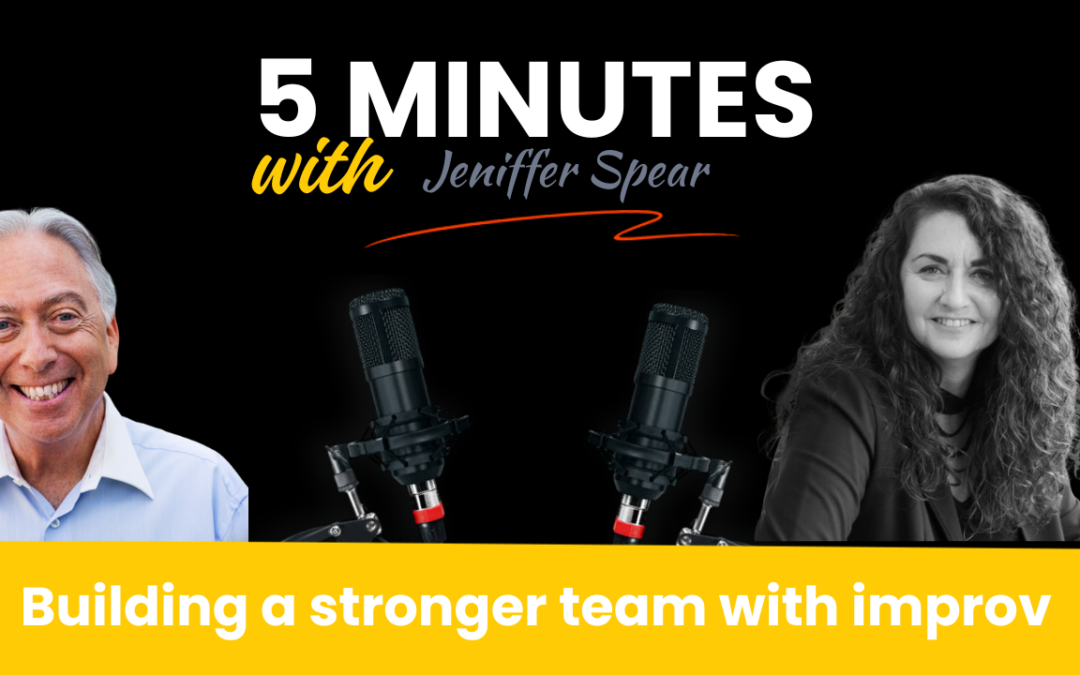
Hall of Fame keynote speaker Michael Kerr (that’s me below!) sits down for a fast-paced and fun conversation with improv and uncertainty expert Jennifer Spear about how the principles of improv can be applied to workplace teams to help them work more collaboratively and help them react to uncertainty and change and be more agile in this rapidly-changing world
Creating a More Change-Ready, Agile Team With the Principles of Improv (transcript)
MICHAEL KERR: Hey everyone. Michael Kerr here with another Five Minutes With… the adorable, the wonderful, the brilliant Jennifer Spear. Jennifer is a dear friend of mine, a colleague. She is a facilitator, extraordinaire. She is a speaker on dealing with change and uncertainty, and she uses a lot of theater improv in her work.
So, I want to talk to her about how theater improv can help us in a workplace setting. Jennifer- how can theater improv help us in a workplace setting?
JENNIFER SPEAR: Well, thank you, Michael, and thanks for having me here with five minutes with Michael. As you know, because you’ve studied and performed improv as well, when we think about improv and an improv team, as an improviser, your role is not to get the spotlight or go for the punchline. Your job as an improviser is really to support the team. It’s to make your scene-mates look good.
Now, could you imagine if we did that at work? I know. And could you imagine if you went into every meeting feeling that way, that your job at that meeting is to support your teammates, to make them look good and to build on their ideas in a positive way?
MICHAEL KERR: Instead of trying to make ourselves look good and hog the spotlight, I love that. And how could our team not rocket if everybody came in with that mindset instead of the dog-eat-dingo competitive mindset we so often have in businesses?
So, Jennifer, help us break this down. What are some theater improv principles that can be applied that would help me as a teammate support the rest of my team and make them look awesome?
JENNIFER SPEAR: Well, I think when we think about improv, anything that is done, said or brought into an improv scene is considered an offer, and it’s your job to accept all offers. So you cannot block or deny an offer. So, anything your teammate says, anything that they bring up, any ideas, those are just offers and it’s your job to accept them. And you use the improv technique that many people have heard of, which is called yes and. And so you accept the idea and then you build on it and you move the scene forward or you take that idea, you add to it, and you build up the idea in a positive way with everybody else on the team.
MICHAEL KERR: Such a simple principle, but we need to remember to do it. So yes and Jennifer, help us understand. Help me deal with a situation where a teammate or maybe my boss even suggests what I think is a pretty crazy outrageous idea. And my first reaction is to turn into a seagull and go and crap all over them and say, “That’ll never work. We tried it in 1997.” Help me get over that initial mindset of being a seagull.
JENNIFER SPEAR: Well, I mean, you want to be open-minded, and so it helps to be curious. And so you want to be curious about the idea, curious about the person, why are they bringing it up? And look for something positive in that idea always, something that you can say “yes” to. You want to leave the assumptions at the side and really listen to what it is that they’re saying and try to see it from their perspective and whether you can build on it or not.
And if you’re in a meeting, I mean, nothing actually happens in a meeting other than the discussions. So why not talk about the ideas and get those exciting big ideas out there because it’s the more you can build up an idea, the better. If someone brings something up, you say “yes and” you make it even better, you add to it because it’s always easier to tame a wild idea than to excite a boring one. So you might as well stretch your thinking while you’re in the room.
MICHAEL KERR: I talk about this in my book, The Humor Advantage, where they have this, I forget the name of the committee, but it’s this great committee and it’s a brainstorming committee and it’s like the outrageous committee. And the metric is if your idea doesn’t make us all leap up and say, “That’s just outrageous,” then it’s considered too tame for what they’re trying to achieve.
Exactly like you said, Jennifer. Yeah, they’re trying to start big with these crazy ideas and then, okay, let’s figure out how we can make this practical, how we can bring it down, tame it, as I think you said, so that we can actually implement this idea.
JENNIFER SPEAR: Yeah, exactly. I mean, the wild ideas, that’s their job, is to get you thinking differently, and then you can make them practical before you actually walk out the door. So that’s always a good thing to do. And if you’re there with that positive mindset that you’re going to support each other, support those ideas, you create that safe environment where people can share their ideas and take risks, and why not do it in that safe space?
MICHAEL KERR: Why not? And that’s the key, making sure it is a safe space where people feel psychologically safe. Thank you, Jennifer, for sharing your brilliance. We’re down to seven seconds. Thank you for being here on Five Minutes With!
For more on this topic, I’ve posted a quick read on the Six Habits of High-Performing Teams.
And for more on managing uncertainty at work, check out Building a Resilient Workplace Culture for Uncertain Times
What do you think!? Let us know! Post your ideas, questions or comments below! How are you creating a more agile, collaborative team at work? Have you ever tried using improv or applying improv principles to your team?
 Known as “The Workplace Energizer!” Michael Kerr is a Canadian Hall of Fame keynote speaker on workplace culture, workplace culture leadership, and humor in the workplace. Michael Kerr is the author of nine books, including Small Moments, Big Outcomes: How Leaders Create Cultures That Fuel Extraordinary Results. Michael is known as one of the most entertaining, humorous, and insightful keynote speakers on workplace culture and leadership in Canada.
“That was the best presentation I’ve seen in my 40 years in business.” Rodney Meadows, Director, East Alabama Home Medical