
How You Can Defuse Conflict at Work
Conflicts at work happen. All the time. Most workplace conflicts are based not on what we say, but how we say things at work.
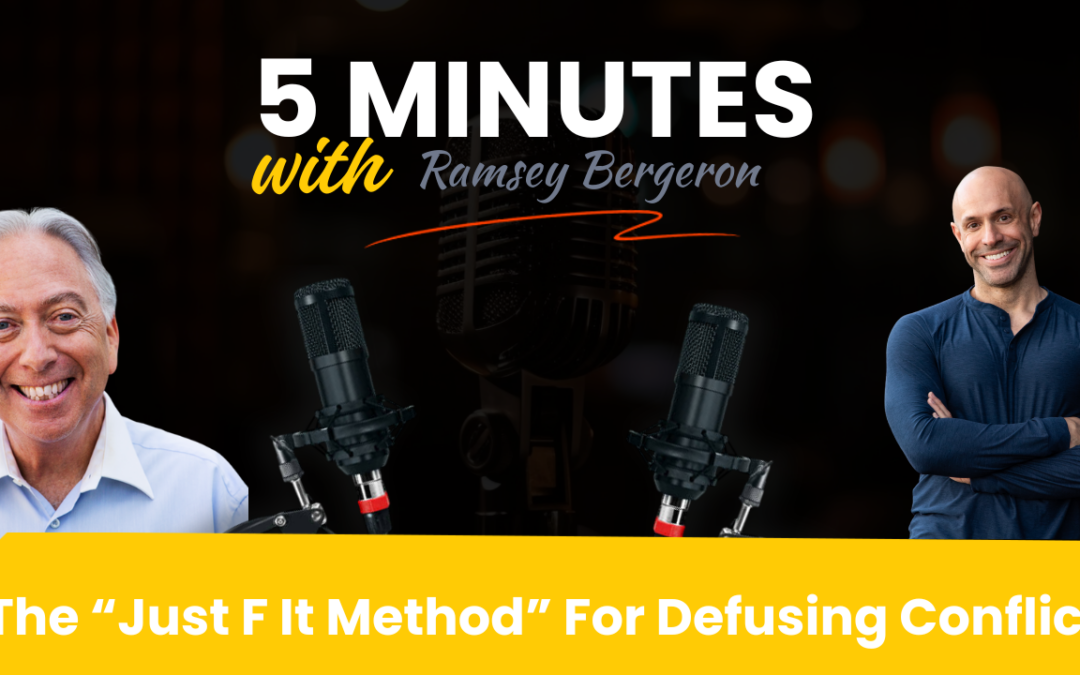
When conflicts at work inevitably arise, what can you do to defuse them? I sat down with Ramsey Bergeron for a “Five Minutes With…” interview where Ramsey shared a simple “Just F It” framework for defusing conflict. (And no, the video does not contain any foul language.)
The Just “F It” Method for Defusing Workplace Conflict
MICHAEL KERR: Hey everyone. Michael Kerr here with another five minutes with. In this case, it is with the one and only Ramsey Bergeron, who is a leadership performance and resilience strategist who is going to talk to us about, well, welcome. Why don’t you introduce it, Ramsey?
RAMSEY BERGERON: Thank you for having me, Michael. It’s a concept called “Just F it.”
MICHAEL KERR: Just F it? I do that on a daily basis. Are we talking about the same thing?
RAMSEY BERGERON: Probably not. These are four Fs to help you reframe any situation that you’re in.
MICHAEL KERR: Okay. All right. So tell us what these four … I’m assuming when you say reframe stressful events, things that happen to us.
RAMSEY BERGERON: Yes, because usually it’s never the situation that causes us stress. It’s how we perceive it. So the first two ‘Fs’: facts and feelings. So let’s get objective. What are the objective facts in the situation? And then how do I feel about it? Because usually I’ll take the feelings and make them facts and they’re not even true.
MICHAEL KERR: Right. Often, is it fair to say that we start with the feelings, right?
RAMSEY BERGERON: Yes, An emotional reaction and then we’ll run off thinking it’s fact, freaking out! And then it’s like, wait a minute, is that even true? So separating facts from feelings is the first pivotal step.
MICHAEL KERR: Okay. I love that. All right. Just get the facts clear in your head. And I’m guessing if we just focus on facts, that probably helps keep our feelings a little in check.
RAMSEY BERGERON: Well, focusing on facts helps us see reality for what it is instead of the story we’re telling ourself. So yes.
MICHAEL KERR: Okay. So facts, feelings. What’s the third F? I’m trying to guess, but I won’t.
RAMSEY BERGERON: Oh, no way. To take a shot. What do you think?
MICHAEL KERR: Fun. I talk about fun a lot. Is it fun?
RAMSEY BERGERON: Well, close. The third ‘F’ is flip it. So what I mean is flip it. Flip the feeling. So let’s say that the stressor is I didn’t get the promotion to work. All right. So it could be like, this is so unfair. I hate this is the feeling that I might be having, but facts. All right. Well, the person that got it, they’ve been there longer. They have more tenure. They have more experience towards it. And so the feeling could have been frustration or anger or annoyance, I didn’t get it.
So if I flip it and I’m okay with that, what would I do different? So if I flip the feeling, well, if I wasn’t mad about it, I’d probably congratulate them and I’d be much more productive at my job. I wouldn’t necessarily stew about it, which would cause a lot of downstream ramifications if I’m showing up. Not only will I not get that job, I might lose mine if I’m being a jerk about it. But if I flip it, all right, if I’m at peace, what would I do differently? And even if I don’t automatically not become upset, doing that does one of two things. It’ll help me realize that no feeling I’ve ever had lasted forever. So flipping it allows me to say, all right, well, this feeling just like everything is temporary, and it creates enough space between me and the story to consider a different point of view.
MICHAEL KERR: Okay. So you’re talking about flipping the feeling that you’re having, trying to-
RAMSEY BERGERON: Yeah, not the table! Flip the feeling that I’m having into a more neutral state. If I flipped it, what would I do differently in the scenario?
MICHAEL KERR: Right. Okay. Love that. Love that. And the fourth F is…?
RAMSEY BERGERON: Future. What would 80 year-old me tell me to do in this situation? Because usually that taps into the wisest, most authentic parts of ourself and it’s like, “Hey, there will be other jobs. That’s fine. This one wasn’t meant to be. What’s within your control? Let it go, man.”
MICHAEL KERR: Yes, that reframing perspective of time and distance, right? Yeah. When you look back at it. So do we really have to look until we’re 80 into the future or could it be even a year into the future?
RAMSEY BERGERON: It could be a year. But I think when we think about, because one year in the future, I might still be pissed off. I’m working where I’m working. I didn’t get the job. Where if you give it enough time, because if I’m 80, hopefully I’m retired, I’m not still working, I have a different perspective on what’s really important to me, and in only one year I might not have that.
MICHAEL KERR: Right. So when you’re 80, is this really going to matter? Is it really going to still matter?
RAMSEY BERGERON: Yeah. Is it going to be all my tombstone that I didn’t get this job promotion back 35 years ago
MICHAEL KERR: Right. All right. So I love that. So let’s review quickly here. We’ve got 40 seconds on the clock. Facts, feelings, flip it, future.
RAMSEY BERGERON: Yes. The four F’s.
MICHAEL KERR: Think about the future. And that is F-ing it. F-ing it to manage your- Just F it. Just F it. Just F it. Just F it. I love it. I love it. And I am now going to think of just F-ing it in a much more positive context, thanks to you.
RAMSEY BERGERON: Well, thank you. Even sometimes just saying, just F it. Again, it’s just enough. It’s almost like fun. It’s just enough to create the story of like, “All right, well, what’s really going on here?” It just gets you out of your own head.
MICHAEL KERR: Yeah. Perfect. I love it. Thank you so much, Ramsey. Four Fs that any of us can use when things kind of go off the rails.
For more ideas on defusing workplace conflict please hop over to my article, Using Humor to Defuse Workplace Conflict
How do you defuse conflict? Please share any tips, suggestion, or questions below!
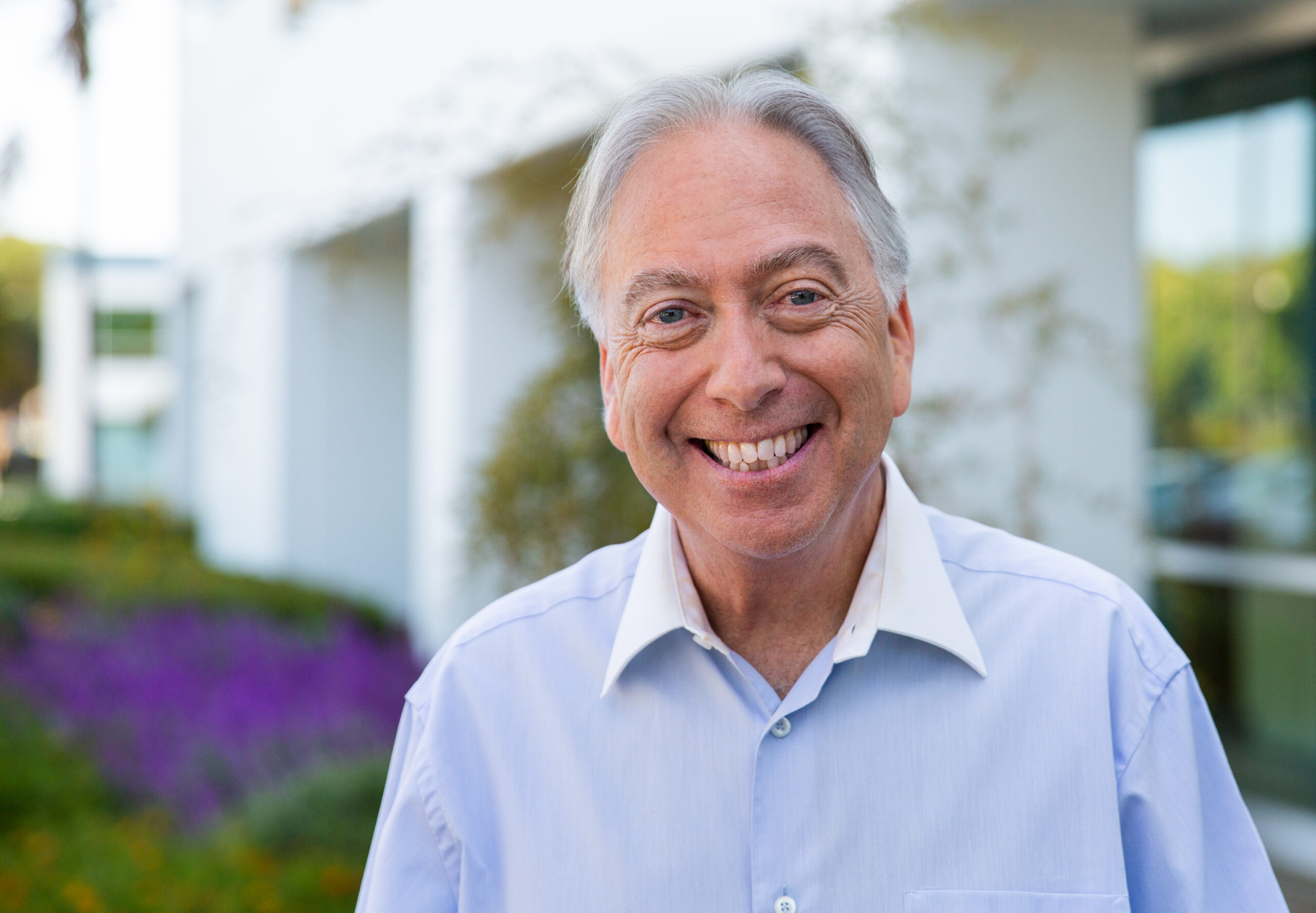 Known as “The Workplace Energizer!” Michael Kerr is a Canadian Hall of Fame keynote speaker on workplace culture, workplace culture leadership, and humor in the workplace. Michael Kerr is the author of nine books, including Small Moments, Big Outcomes: How Leaders Create Cultures That Fuel Extraordinary Results. Michael is known as one of the most entertaining, humorous, and insightful keynote speakers on workplace culture and leadership in Canada.
“By far, Michael Kerr was the best speaker we ever had.” Rod Smith, VP Business Development, Century Vallen